
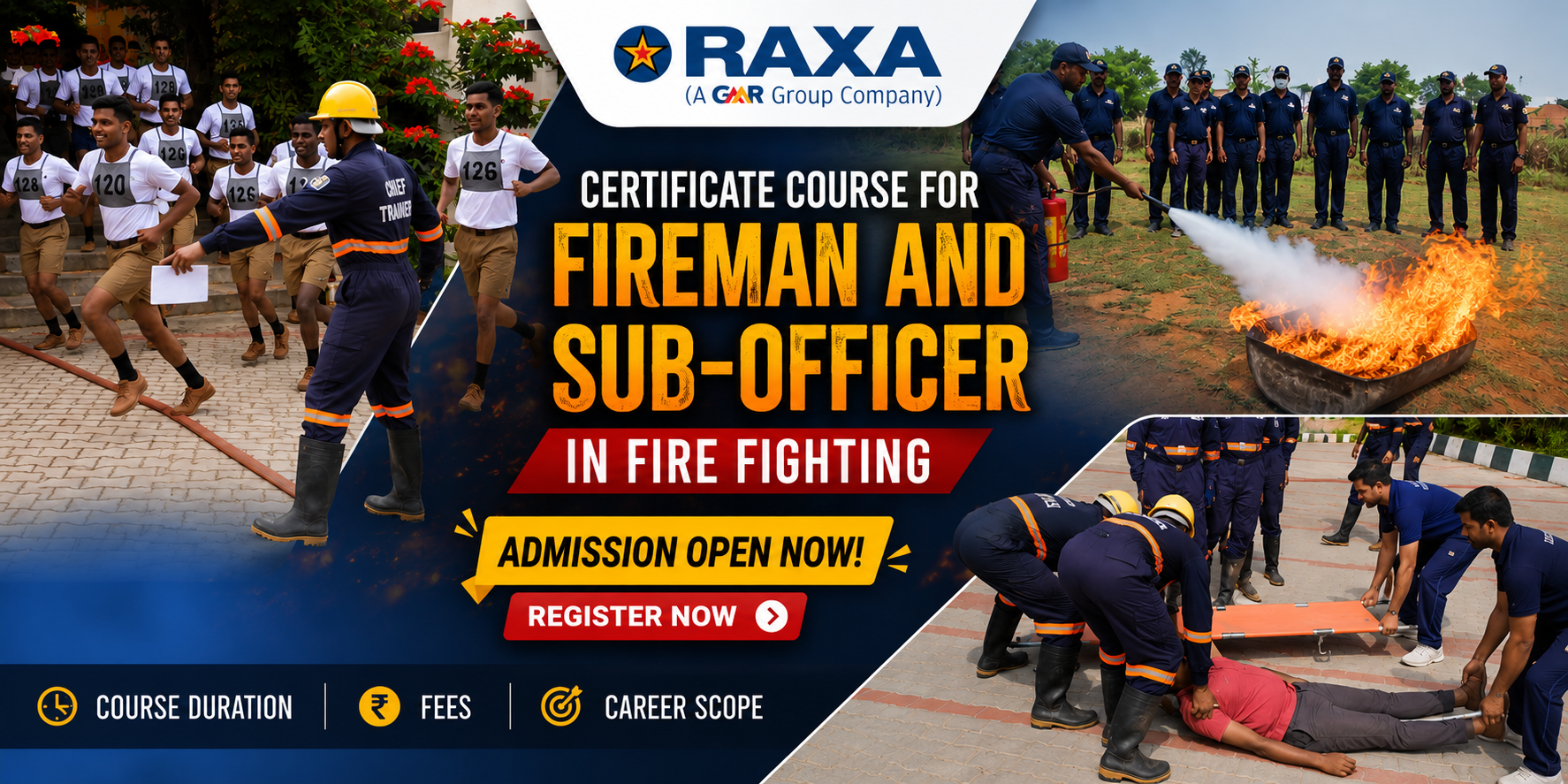
Every single day, we see news headlines about devastating structural blazes, electrical short-circuits in commercial high-rises, and industrial plant fires that destroy livelihoods in seconds, and India alone records over 25,000 fire incidents annually, which is a staggering statistic highlight the harsh reality of how fire hazards are expanding faster than our current safety infrastructure can handle, and why we need professionals with a Certificate Course for Fireman and Sub-officer in Fire fighting. Especially when an emergency strikes, we cannot just wait and hope for the best; we need highly trained, quick-thinking professionals who know exactly how to manage, prevent, and suppress these crises.
Because of this pressing reality, the demand for certified safety professionals has skyrocketed across the country, and thus, if you are looking for a stable, high-impact, and rewarding career path, pursuing a Certificate in a fire and safety course might just be your perfect next move. Wondering how? In this guide, we will break down everything you need to know to start this journey and cover the basics of a Certificate in fire and safety management. For more details about the duration of the course, fees, and incredible career paths after the course, read on and discover how RAXA’s Academy accredited with Rastriya Raksha University (RRU), in different firefighting courses operating across 19 states, can give your career a massive competitive edge.
A Certificate Course for Fireman and Sub-officer in Firefighting are specialized program curated to train individuals in fire prevention, occupational safety, industrial hazard management, emergency response, and workplace safety regulation.
A certificate in fire and safety management can amalgamate technical knowledge with pragmatic skills, so students can learn how to identify hazards, reduce workplace risks, conduct safety audits, and manage emergency situations without any hiccups. In fact, a comprehensive fire and safety management course usually combines:
| Profile | Benefit |
|---|---|
| Job seekers | Gain industry-ready skills and better employability |
| Working Professionals | Upskill and move into HSE or safety roles |
| HSE Aspirants | Build a robust foundation in occupational safety |
| Industrial Supervisors | Improve workplace safety in leadership skills |
In fact, the course from RAXA is especially valuable for 12th-pass students who are seeking careers in sectors where safety compliance is mandatory.
One of the most common questions that students ask is about the Certificate Course for Fireman have Six months duration residential program at our Raxa Academy with 04 weeks OJT and Sub-officer in Firefighting Course duration is 9 months. program includes classroom learning, practical training, and industry expertise. To further clarify things, here’s what a standard structure often looks like:
| Course Level | Duration | Eligibility | Ideal For |
|---|---|---|---|
| Certificate Fireman course | 6 months | 10th/12th | Beginners |
| Sub-Officers Course in Firefighting | 9 Months | 12th/ITI | Career aspirants |
When you are researching the fire and safety course fees, students quickly realize that the pricing varies significantly depending on the reputation of the institute, accreditation, infrastructure, and placement support. In India, the typical fire and safety course fees may range from:
RAXA also offers competitive structured pricing with EMI and installment options, which helps students access quality education without excessive financial pressure.
| Institute Type | Accreditation | Placement Support |
|---|---|---|
| Local institute | Varies | Limited |
| Private training academy | Moderate | Available |
| Accredited institution | Recognized | Strong |
| RRU-linked programs | High credibility | Industry-focused |
A modern certification in fire and safety management goes far beyond textbook learning because today’s fire and safety management course curriculum focuses on preparing students for a real industrial environment. Here’s what the courses include in each semester:
RAXA follows an RRU-accredited, industry-aligned curriculum that’s designed around actual workplace requirements. The module breakdown includes:
| Module | Topics Covered | Mode |
|---|---|---|
| Fire Science | Fire behaviour, combustion | Theory |
| Fire Prevention | Prevention systems | Theory + Practical |
| Hazard Management | Industrial risks | Theory |
| Emergency Response | First aid and rescue | Practical |
| Industrial Safety | Regulations and audits | Theory + Practical |
A fire and safety officer course can prepare candidates to become professionals responsible for maintaining workplace safety and emergency preparedness. In fact, a fire safety officer typically handles:
The role of fire safety officers in India is rapidly increasing due to stringent regulatory requirements, and industries that are actively hiring include:
Mostly, career growth often follows this path:
RAXA can train learners through industry-experienced instructors and practical simulations, so the new trainees can meet real-world expectations.
Choosing between basic fire safety training, and a certification course can be confusing, and to differentiate these three clearly, here are some pointers that you can consider:
These are short programs lasting for 1-5 days, and they cover:
A fire safety certification course can typically last for about 3-6 months, and it includes broader safety management topics.
A 6-9 months certification can provide extensive technical and managerial learning, and the program is great for those who are looking for a rather holistic course.
| Feature | Basic Training | Certification Course | Sub-Officers |
|---|---|---|---|
| Duration | 1-5 days | 6 months | 9 Months |
| Eligibility | Anyone | 10th/12th | 12th/ITI |
| Career Use | Awareness | Mid-level roles | Full career path |
| Salary Impact | Low | Moderate | High |
| Certification | Participation | Certificate | Certification |
Many students and professionals start with a fire safety certification course before progressing to advanced qualifications. The certification process is generally straightforward, and it includes the following steps:
For one, you can select a recognized institute that offers accredited training.
The topics might include:
Hands-on learning usually covers:
Students can undergo written and practical examinations in the assessment cycle.
After successful completion of the course program, learners can receive a fire and safety certification in India that employers can recognize. RAXA offers multiple levels, including:
Its certification framework typically aligns with NDMA recommendations and workplace safety requirements, and the certification credibility also matters because industries are increasingly preferring candidates with recognized qualifications and hands-on experience. Here are some industries where employers are prioritizing candidates with a certification in fire and safety certification:
Especially for professionals who are working in industrial environments, certifications can also support promotions and salary growth.
The scope of a fire safety career in India is expanding rapidly, and graduates can pursue roles such as:
Government opportunities are also available through state fire departments and public sector organizations. India's industrial expansion and Smart Cities initiatives continue creating demand for certified professionals with specialized skills and RAXA's placement support and industry partnerships further help graduates connect with employers.
When you are selecting a training institution, the curriculum quality alone isn’t enough, because industry recognition and practical exposure are also important. RAXA offers several advantages, including:
Beyond infrastructure and curriculum, RAXA emphasizes experiential learning that mirrors real workplace conditions. Students are trained through scenario-based exercises, mock emergency situations, and hands-on practice with firefighting equipment, helping them develop confidence before entering the industry. The institution also focuses on creating job-ready professionals by aligning training with current hiring requirements across sectors.
Another key advantage is exposure to diverse industries. Since RAXA, backed by the GMR Group, serves sectors such as aviation, healthcare, power plants, retail, pharma, and corporate environments, students gain broader insights into varying safety protocols and operational challenges. This multi-industry perspective prepares candidates to adapt quickly in different work environments. Combined with experienced trainers and practical skill development, RAXA aims to bridge the gap between classroom education and real-world safety responsibilities.
The enrolment process is simple:
For more information or to get an estimate, feel free to contact the team at RAXA, a GMR Group Company today! Our team of professionals will be more than happy to help you with your queries and provide you a quote!
Certificate Fireman Course Residential programs run for 6 Months and Sub-Officers Course will be for 9 months include classroom learning, practical sessions, internships, and industrial exposure. Some institutions divide the curriculum into two semesters with theory and practical components.
The fees for a fire and safety certification course in India can vary depending on accreditation, facilities, and placement support. So, feel free to reach out to our team to get more details about the course fee.
Most institutions, including RAXA, accept 12th-pass students and ITI graduates. Eligibility may vary by institution and program structure, so that’s the minimum eligibility to join a Certificate Course for Fireman and Sub-officer in Firefighting.
Basic training focuses on awareness and emergency response. Certificate courses provide technical knowledge, practical training, and career-oriented learning.
Entry-level professionals generally earn a reasonable amount monthly, while experienced professionals can earn significantly higher salaries.
Construction, oil and gas, aviation, healthcare, manufacturing, infrastructure, and government organizations frequently hire trained professionals.
Industrial growth, infrastructure projects, and stricter compliance requirements have created strong demand for trained fire and safety professionals across sectors, so the scope is quite massive.